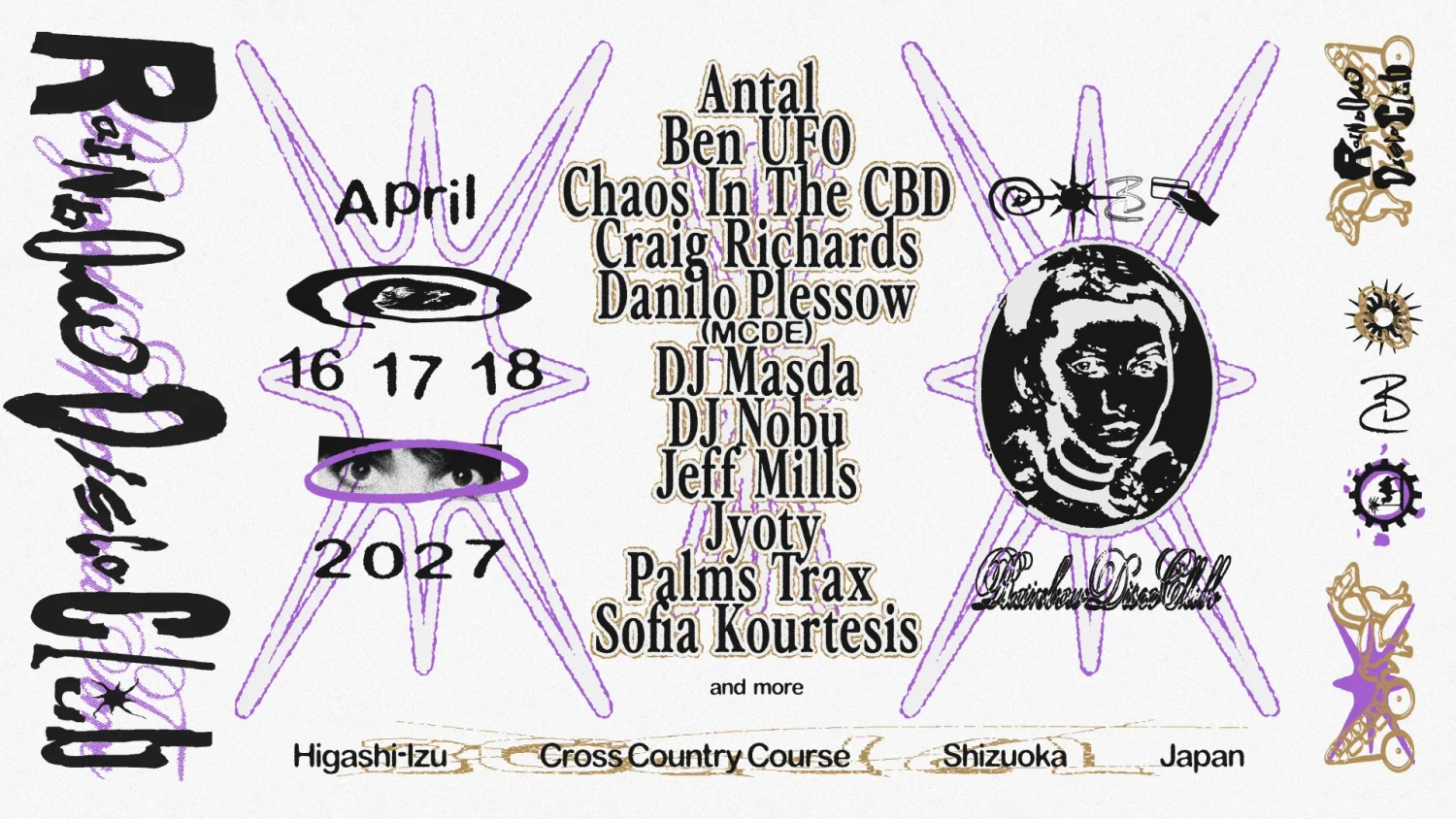
Rainbow Disco Club 2027 has opened its first artist chapter, and it is exactly the sort of patient, deep-digging bill that suits a hillside dance floor. From April 16–18, 2027, the festival returns to the Higashi-Izu Cross Country Course in Shizuoka with Jeff Mills, Ben UFO, Sofia Kourtesis, Palms Trax and seven more artists confirmed so far.
This is a first wave rather than the finished programme – the official poster ends with “and more” – but it already feels coherent. Detroit futurism, London bass pressure, warm house music and Japan’s own underground lineage all have room to breathe.
Essential Details for Rainbow Disco Club 2027
- Dates: April 16–18, 2027
- Location: Higashi-Izu Cross Country Course, Shizuoka, Japan
- Lineup status: First wave – 11 artists announced, with more to come
- Tickets: Tiered three-day, camping and parking options are available through the official ticket page
- Getting there: The festival lists Izu-Inatori as the nearest station, with a direct Odoriko service from Shinjuku taking roughly two and a half hours
A lineup built for the long journey
Jeff Mills is the immediate gravitational force. The Detroit pioneer has spent decades treating techno as something bigger than a club format – part machine music, part science fiction, part physical discipline. Hearing that precision outdoors in Higashi-Izu should be one of the weekend’s defining moments.
Ben UFO offers a different kind of authority. As a co-founder of Hessle Audio and one of dance music’s great DJs, he can connect UK garage, techno, house, dubstep and stranger rhythmic corners without making the transitions feel forced. Rainbow Disco Club rewards selectors who think in arcs rather than quick highlights, which makes this booking especially sharp.
Sofia Kourtesis brings melody and emotional weight to the bill. Her album Madres turned personal history into luminous club music, and her sets can move from tenderness to release without losing momentum. Alongside her, Palms Trax should supply the kind of bright, expansive house and disco selections that make perfect sense under an open sky.
The diggers, residents and scene-builders
The supporting names are not filler. Antal, co-founder of Amsterdam institution Rush Hour, has the record knowledge to move through boogie, house, jazz, Afro-diasporic rhythms and left turns that resist easy classification. Craig Richards brings decades of experience from fabric and Houghton, with a patient, psychedelic approach that can reshape a dance floor over several hours.
Danilo Plessow (MCDE) remains one of the best bridges between deep record collecting and immediate dance-floor pleasure. The Motor City Drum Ensemble producer’s sets can pull from soul, disco, house and jazz without turning into a history lesson. Chaos In The CBD operate in similarly warm territory, pairing dusty house textures with a relaxed but deceptively detailed groove.
Japan’s underground is central, not decorative
DJ Nobu has helped shape Japan’s underground techno culture through Future Terror and a fearless approach to pacing and atmosphere. DJ Masda, co-founder of Cabaret Recordings, is a meticulous vinyl selector whose sets often find the strange connective tissue between house and techno. Their presence keeps the programme grounded in the scene that built Rainbow Disco Club rather than treating local artists as an afterthought.
Then there is Jyoty, whose energetic, fast-moving sets can jump between house, UK sounds, R&B edits and global club music while keeping the crowd firmly in the conversation. On a lineup this considered, her unpredictability is a feature.
Why Rainbow Disco Club feels different
Rainbow Disco Club began in 2010 and has grown without adopting the anonymous scale of a mega-festival. The setting matters: a single outdoor gathering in the hills, music that stops at midnight, and a campsite that becomes part of the social rhythm rather than an inconvenient place to sleep.
The festival’s “Beyond Space and Time” idea is visible in this first wave. The booking does not split dance music into neat generations or national scenes. Detroit sits beside London, Berlin, Amsterdam and Japan; established names share the poster with artists whose influence comes from radio, labels, record shops and long-running parties.
The practical stuff
Plan the rail journey early. Higashi-Izu is not central Tokyo, and that distance is part of the experience. The official route uses Izu-Inatori station, followed by a short local bus or taxi trip to the site.
Camping needs its own ticket. On-site and off-site camping options are sold separately from festival admission. Parking is also ticketed, so driving without the correct pass is not a good improvisation.
Expect a partial lineup. Eleven artists are confirmed, but the poster explicitly promises more. Do not build a detailed day-by-day plan yet: no official artist schedule or set times have been published.
Prepare for changing spring weather. A hillside in Shizuoka can move between sun, cool evenings and rain. Layers, waterproof footwear and proper camping equipment will matter more than another outfit change.
Rainbow Disco Club’s first 2027 wave does not shout for attention. It earns it. The names are strong individually, but the real appeal is the conversation between them: Jeff Mills‘ futurism, Ben UFO‘s genre-fluid instincts, DJ Nobu‘s intensity and Sofia Kourtesis‘ emotional sweep all belong to the same carefully built weekend.
See ticket options and future lineup updates on the official Rainbow Disco Club 2027 ticket page.