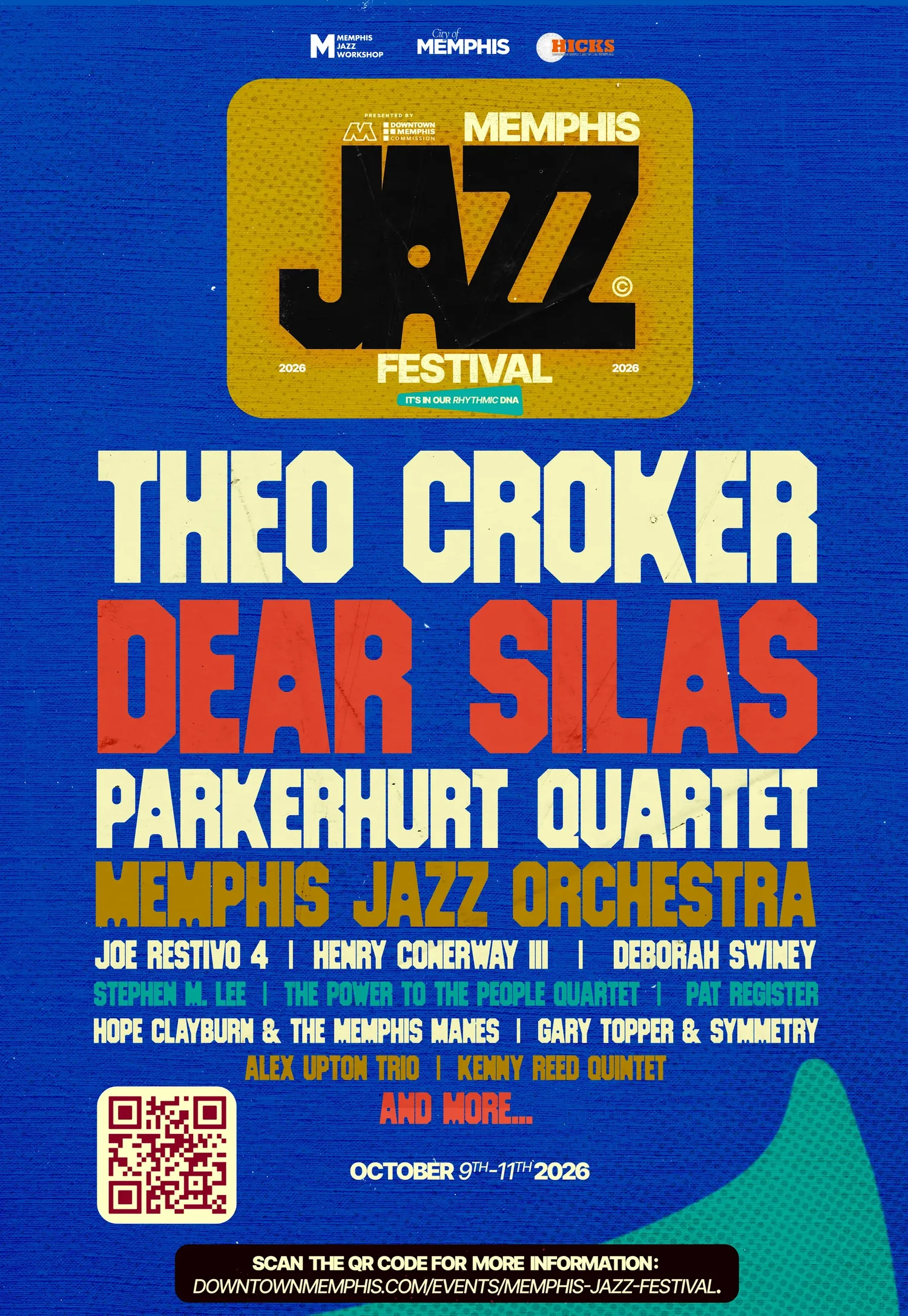
Memphis Jazz Festival is making its first entrance with a lineup that understands exactly where it is. On October 9–11, 2026, Downtown Memphis will turn three days of hotels, pedestrian streets, late-night rooms and public parks into one connected jazz weekend, led by Theo Croker and Dear Silas.
The headliners bring modern jazz into conversation with hip-hop, soul and electronic production, while the rest of the bill stays rooted in the musicians, educators and ensembles carrying Memphis jazz forward every week. Better still, the inaugural edition is free and open to the public. That is not a soft launch. It is a statement of intent.
Essential Details for Memphis Jazz Festival 2026
- Dates: October 9–11, 2026
- Location: Main Street Mall, The Westin Memphis Beale Street, The Dame at Hotel Pontotoc and Court Square Park, Downtown Memphis, Tennessee
- Admission: Free and open to the public, with information and registration through Downtown Memphis
- Airport: Frederick W. Smith International Airport (MEM)
- Getting around: The Main Street corridor is pedestrian-focused. MATA currently operates trolley buses along Main Street, while Downtown Memphis also lists garages and surface lots near Peabody Place and South Main
A Headline Pair That Refuses the Museum Treatment
Theo Croker is the clearest signal that this festival is interested in where jazz is going, not only where it has been. The trumpeter, composer and producer earned a Grammy nomination for Star People Nation, then kept stretching his sound through BLK2LIFE: A Future Past, Love Quantum and 2025’s Dream Manifest. His music can move from propulsive swing to cosmic soul and experimental hip-hop without turning any of those ingredients into decoration.
That makes Croker an excellent first-year headliner for Memphis. This is a city that has never respected neat genre borders, and his work treats tradition as a launchpad rather than a cage.
Dear Silas arrives from Jackson, Mississippi with a similarly Southern but very different hybrid. He is a rapper, singer and trumpet player whose catalog folds jazz and soul into hip-hop and R&B. His breakout track “Skrr Skrr” pushed him to a wider audience, while “I Ain’t Stressin’ Today” later became a viral hit and received a remix featuring Snoop Dogg. On this lineup, he is not the pop crossover booking awkwardly placed beside the jazz acts. The trumpet is part of his musical language, and the blend makes sense.
Putting Theo Croker and Dear Silas at the top is a smart piece of programming. One approaches contemporary music from modern jazz outward; the other brings jazz phrasing and instrumentation into rap and R&B. The shared ground is exactly where an inaugural festival should plant its flag.
The Memphis Lineup Is the Real Foundation
The national names will draw attention, but the local bill gives Memphis Jazz Festival its identity. Memphis Jazz Orchestra brings the scale and punch of a large ensemble, while Parker-Hurt Quartet and Joe Restivo 4 keep the focus on small-group interplay. Guitarist Restivo has long moved across the city’s jazz, soul and blues vocabulary, making his quartet a natural fit for a festival built around Memphis’s overlapping musical traditions.
Stephen M. Lee, founder and artistic director of Memphis Jazz Workshop, represents the education pipeline behind the city’s next generation of players. The Workshop combines performance training with music theory, jazz history, improvisation and mentorship for young musicians. Its presence around this festival matters because a sustainable scene needs more than stages. It needs teachers, rehearsal rooms and young players who can imagine themselves belonging on those stages.
That network continues through drummer Henry Conerway III, vocalist Deborah Swiney, saxophonist Gary Topper with Symmetry, and The Power to the People Quartet. Topper’s credits reach from Memphis sessions to work connected with Stevie Wonder, Ray Charles, Al Green, Keith Richards and Jimmy Buffett, a career that mirrors the city’s habit of letting jazz musicians travel freely between styles.
The bill is completed by Pat Register, Hope Clayburn & The Memphis Manes, Alex Upton Trio and Kenny Reed Quintet. It is a lineup with enough range to move from orchestra arrangements and straight-ahead quartet language into funk, soul-jazz and more open contemporary forms. More importantly, it does not treat Memphis musicians as anonymous support beneath two imported headliners. Their names dominate the poster because they are the festival’s backbone.
Three Days, Four Different Downtown Experiences
Friday, October 9 begins with Jazz After Hours at The Westin Memphis Beale Street. Hosted by Strictly Jazz Entertainment, the opening night is positioned as a hotel-lounge welcome: live music, cocktails and a softer entry into the weekend rather than a full outdoor festival day.
Saturday, October 10 is the centerpiece. From 1 p.m. to 7 p.m., the festival takes over Main Street Mall between Peabody Place and Union Avenue with two stages of live entertainment and jazz workshops. The setting is a strong choice. Main Street Mall is a pedestrian and transit corridor, so the music sits directly inside Downtown rather than behind the gates of a remote event field.
Saturday continues after the outdoor program with a Jazz Jam at The Dame, the intimate basement room inside Hotel Pontotoc. Hosted by Henry Conerway III and sponsored by Memphis Jazz Workshop, the jam is where the polished festival bill can loosen its collar. Jazz festivals are often remembered for the unplanned combinations that happen after the formal sets, and The Dame gives this inaugural edition a place for exactly that.
Sunday, October 11 closes at Court Square Park from 3 p.m. to 7 p.m. with the season finale of Sunset Jazz. That connection is significant: the new festival is not appearing from nowhere, but growing from an existing Downtown concert series and the community already built around it.
Why Memphis Needs This Festival
Memphis is internationally marketed through blues, soul, gospel and rock ‘n’ roll, which is fair until that familiar story starts hiding everything else. Jazz belongs inside the city’s musical history too. The inaugural Memphis Jazz Festival makes that case without turning the weekend into a history lecture.
The smartest part of the concept is its balance. Theo Croker brings a forward-facing national jazz profile. Dear Silas breaks down the wall between jazz and Southern hip-hop. The Memphis ensembles provide the local language, while the workshops and jam session make participation part of the program. This is not simply fourteen names printed on a poster. It is a compact picture of how a scene survives: headline attention, working musicians, educators, students, public spaces and late-night exchange.
Making the event free removes another barrier. A first-year festival needs curiosity more than exclusivity, and Downtown Memphis Commission has designed a weekend where someone can plan a full visit or simply encounter a set while walking Main Street.
The Practical Stuff
Build your Saturday around Main Street. The two-stage program runs from 1 p.m. to 7 p.m. between Peabody Place and Union Avenue. Arrive early enough to orient yourself before the workshops and performances begin, especially because detailed artist set times have not yet been released.
Do not treat Friday and Sunday as bonus days. Friday’s Westin program, Saturday night’s jam and Sunday’s Court Square finale are deliberately different environments. The whole weekend is closer to a Downtown jazz crawl than three identical festival days.
Check the official page before travelling. The organizer has announced the artists and broad weekend structure, but the detailed performance schedule is still to come. Use the official Memphis Jazz Festival page for updates.
Use the Downtown transport network. Main Street Mall is designed around pedestrians and transit rather than general vehicle traffic. MATA’s Main Street trolley bus currently runs Monday through Saturday from 8 a.m. to 10 p.m. and Sunday from 8 a.m. to 6 p.m., but service details can change, so verify the current schedule before the festival.
Flying in is straightforward. Frederick W. Smith International Airport offers rental cars, taxis, shuttles and MATA bus service from the baggage level. For a weekend concentrated in Downtown venues, staying near Main Street or Beale Street will reduce the amount of back-and-forth travel.
A First Edition With a Point of View
Plenty of new festivals launch with a random collection of available names and figure out their personality later. Memphis Jazz Festival already has one. It is contemporary without dismissing tradition, local without becoming insular, and public without feeling lightweight.
The detailed set times will determine how the weekend flows, but the foundation is strong: Theo Croker and Dear Silas at the top, Memphis artists across the bill, education and improvisation built into the format, and Downtown itself serving as the venue.
See the latest updates and register through Downtown Memphis.